John James Audubon
This information previously appeared on our home page
John James Audubon's Birds of America
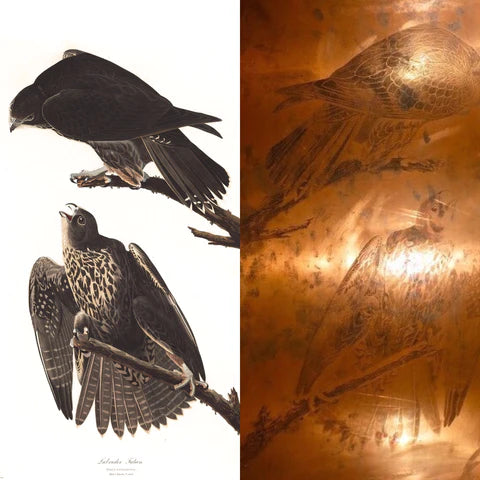
Between 1827 and 1838, John James Audubon, brilliant artist and naturalist who dedicated much of his life to painting the birds and quadrupeds of North America, published in London, England, in 'his own style', a series of 435 large-sized, hand-colored etchings with aquatints in a watercolor folio entitled The Birds of America. These were reproduced primarily by Robert Havell and Sons from Audubon's watercolor studies and often under the direct supervision of Audubon himself. Since he portrayed each bird life size, the larger birds often were depicted in feeding positions to fit on the largest copper engraving plates then available, approximately 27 x 39 inches. The largest bird was the wild turkey, and the smallest was one of the minute hummingbirds. With the final publication of these prints, Audubon established his Birds of America as the definitive portrayal of American birds in realistic settings. These antique original prints, now more than 180 years old, are known in the print trade as Havells or Double Elephants because each was printed on giant "double elephant" folio sheets.
What's a double elephant?
"It is now a month since my work was begun by Mr. Lizars; the paper is of unusual size, called 'double elephant', and the plates are to be finished in such superb style as to eclipse all of the same kind in existence." - J.J. Audubon, December 10, 1826
And 'eclipse all' he did! No other ornithology prints could measure up to Audubon's - literally! As indicated above, the term 'double elephant' refers to the unusual (double) size of the paper used by Audubon and his engravers (Havell followed Lizars) for the original "Birds of America." The untrimmed paper measured a gargantuan 29 1/2 x 39 1/2 inches! Officially, the proper English measurement for double elephant paper is 40 x 27 inches - untrimmed. Elephant paper is a bit smaller, measuring 28 x 23 inches untrimmed. Why such a large (double) size? Audubon insisted that each bird be depicted life-size. When you consider the immense proportions of subjects such as the Brown Pelican or of the White Pelican or the American Flamingo, the necessity of choosing 'double elephant' paper becomes obvious.
"Merely to say, that each of my illustrations is of the size of nature, were too vague ... Not only is every object, as a whole, of the natural size, but also every portion of each object. The compass aided me in its delineation, regulated and corrected each part, ... The bill, the feet, the legs, the claws, the very feathers as they project one beyond another, have been accurately measured." - John James Audubon. Ornithological Biography, Volume 1
Audubon Viviparous Quadrupeds
Following the momentous accomplishment of his extensive project, The Birds of North America, John James Audubon turned his focus towards exploring the realm of mammals. Teaming up with his two sons, Victor Gifford and John Woodhouse, they joined forces with Mister John Bachman, who offered valuable textual insights and played a crucial role in managing the research initiatives. The knowledge he acquired from studying birds allowed him to refine his technique to a point where he produced his finest work focusing on these mammals. The Viviparous Quadrupeds of North America, an incredibly detailed work, was officially published in three volumes between 1845 and 1848. About 303 sets printed in the Imperial size make these original lithographs rare and highly valuable today. Each measures 22 x 28 inches and features the legend "Lith. Printed & Cold. by J.T. Bowen, Phila."
Numbers on Audubon prints?
Small numbers within the image correspond to the type, sex or maturity as noted in the script at the bottom of each image.
The larger number at top left of the paper is a group number. There were 87 such groups consisting of 5 prints in each. The number at top right is the individual plate number, from 1 to 435. Interestingly, plate numbers ending with a 1 or 6 will be a larger bird or composition. Why? Audubon released prints to subscribers in groups of five, with the first print in each group generally being a large bird or a full page composition.
Victoria's secrets?
J Whatman paper
Audubon selected Whatman paper for his originals. This paper, manufactured in Kent, England, was renowned for its quality. James Whatman, the creator of wove paper, continued producing it until his passing in 1759. The business was then taken over by his son James, who later sold it to Thomas Hollingsworth in 1792. The Hollingsworth family carried on the papermaking tradition until 1976. The dimensions of this double elephant paper are approximately 29 x 39 inches, and it features a watermark on the back - J WHATMAN - along with a date. Some sheets also bear the countermark TURKEY MILL, which is believed to reference the mill's original purpose of grinding Turkey wheat from India. The watermark can be seen on the back of untrimmed Havells while held up to a source of light and stretches across the paper for about 10 inches. Look a few inches within the long edge of the paper. Notably, important figures such as George Washington and Napoleon utilized Whatman paper for significant documents. Even Queen Victoria herself employed Whatman paper for her personal stationery.

John James Audubon's Birds of America
1) Original Audubon Havells
2) Original Bien Edition
3) Original Octavos
4) Octavo Test Sheets
Audubon's Viviparous Quadrupeds
1) Original Imperials
2) Imperial Test Sheets
3) Original Octavos
4) Octavo Test/Pattern Prints
Consigning? Click here.
"Princeton Audubon Prints and Ed were simply amazing to work with. Ed is knowledgeable, communicative, honorable, and patient. He deftly handles transactions and shares in the enthusiasm of both seller and buyer. He marketed and sold several beautiful Audubon original elephant folio prints on my behalf. I look forward to another opportunity to work with him."
What is an Audubon print?
An Audubon print is either an original produced by Audubon and/or his family during the nineteenth century or any of the later reproductions. Audubon produced prints on paper, as did those who produced reproductions. They are all Audubon prints, a rather generic term. Thus, it is best to differentiate by simply terming the originals as original Audubon prints. We advise caution as several Audubon print websites do not clearly distinguish between nineteenth century originals and their own reproductions, sometimes terming their reproductions as Havells (Audubon's engraver) instead of reproductions of Havells. You will also often see common reproductions on sites such as eBay presented as originals. Further, Audubon prints advertised as vintage are usually reproductions of little or no value.
Click here for an Audubon print primer.
How can I tell if my Audubon print is real and authentic?
Authenticate original Audubon prints
The dimensions for Havells on average are 26 1/4" x 39 1/4". Occasionally, about an inch more or less is trimmed from one of the longer sides where previous owners may have removed original binding marks. Additionally, there often is a rectangular impression, a border within the paper border, that surrounds the printed image. This is caused by copper engraving plates being pressed into the dampened paper. Here is a comprehensive list of all double elephants, along with their respective copper plate sizes. The size of the impression should match this list. Be careful, since some reproductions have false plate impressions. If unsure, gently run the tip of your index finger from the center of the image all the way across the plate mark. A true plate impression will be smoother within the impression than outside. This is because the pressure from the copper plate smoothed out the ridges and valleys in the paper, leaving the area outside the copper plate untouched,
If the print is unframed, carefully hold it up to a source of light and view the back. All untrimmed Audubon double elephant folio Birds of America prints have a visible countermark. Here is what it should look like. However, finding the countermark on larger images may be difficult since ink may obscure it. The countermark is like a watermark, but it consists only of lettering and lacks artistic elements. It stretches about 10 inches across the paper and is approximately 1 inch in height. The countermark is either 'J Whatman/Turkey Mill' or 'J Whatman' with a date following, typically ranging from 1825 to 1838.

It says, 'Drawn from Nature by JJ Audubon.' So, is it original?
Not likely. It's important to clarify that the presence of script at the bottom of a print—stating it was "drawn from nature by Audubon" or "engraved by Havell or Bowen"—does not in itself confirm the print as an original. High-quality reproductions also include this script because it is an integral part of the artwork. This inclusion can inadvertently lead some collectors to believe they possess an original piece. The real concern arises when dealers misrepresent reproductions as genuine Havell engravings, or when terms like "vintage" are used without proper qualification. In these cases, the language is misleading and can create confusion about the print's true authenticity.
Always verify claims with clear, qualified information to ensure that the authenticity of a print is accurately represented.
What is the value of an Audubon print?
All original Audubon prints have value. However, there is no price list since each print differs from the other regarding condition and provenance. Guidance can be given based on auction and private sales. All prices listed for originals on the Internet or bricks and mortar stores should be considered asking prices. The smallest of Audubon originals, the octavo birds and mammals can have a value of less than one hundred dollars to several thousand dollars, depending on the popularity of the image and condition of the print. Imperial mammals which measure about 21 x 28 inches are generally valued from about five hundred dollars to tens of thousands of dollars, again depending upon the popularity of the image and condition of the print. Audubon Havells rarely sell for less than one thousand dollars for smaller images but can sell for upwards of one hundred and fifty thousand for the larger images, again depending upon the popularity of the image and the condition of the prints. Interestingly, Audubon double elephant prints with a plate number ending in the number 1 or 6 will generally be the most valuable.
Are Audubon's double elephant prints life-size?
Yes. The birds in the foreground of Audubon double elephants are exactly life-size. But to this Audubon adds, ""Merely to say, that each of my illustrations is of the size of nature, were too vague ... Not only is every object, as a whole, of the natural size, but also every portion of each object. The compass aided me in its delineation, regulated and corrected each part, ... The bill, the feet, the legs, the claws, the very feathers as they project one beyond another, have been accurately measured." John James Audubon. Ornithological Biography, Volume 1